Why your baby wakes up as soon as you put them down (and how to make the transition more gentle)
Guest blog by midwives Annelies and Elke from Mom & Me.
You probably recognize the moment: your baby is sleeping peacefully in your arms. Their breathing is calm and their little face relaxed. And then, just as you gently try to lay them down, their eyes open again or they begin to fuss softly.
For many parents, this is a familiar and sometimes frustrating experience. Yet it is important to know that this behavior is completely normal. Babies naturally feel safest when they are close to their parents. Your warmth, scent and heartbeat give them a sense of security that they still need to learn to trust in a crib.
Laying a sleeping baby down is not a trick you instantly master. It is a process you and your baby learn together. As midwives, we are happy to share a few gentle and practical tips that can make this moment feel just a little easier.

Wait until your baby is truly in a deep sleep
Many babies fall asleep quickly, but that does not mean they are already in a deep sleep. During the first minutes, their sleep is still light and they can easily wake with even small changes.
Try to look beyond closed eyes and notice signs of deeper relaxation:
Are the arms resting loosely?
Are the little hands open?
Is the breathing calm and steady?
It usually takes about twenty minutes for a baby to enter a deeper sleep phase. By waiting a little before laying your baby down, you increase the chances that they will continue sleeping peacefully.

Lay your baby down gently: bottom first, then the head
The way you lay your baby down can make more of a difference than you might think.
Try placing your baby down in calm, gradual steps: first the bottom, then slowly the back, and finally the head.
This helps avoid the sudden sensation of “falling,” which can trigger a startle reflex in many babies. This technique also works well when your baby is sleeping in a swaddle or a swaddle sleep sack.
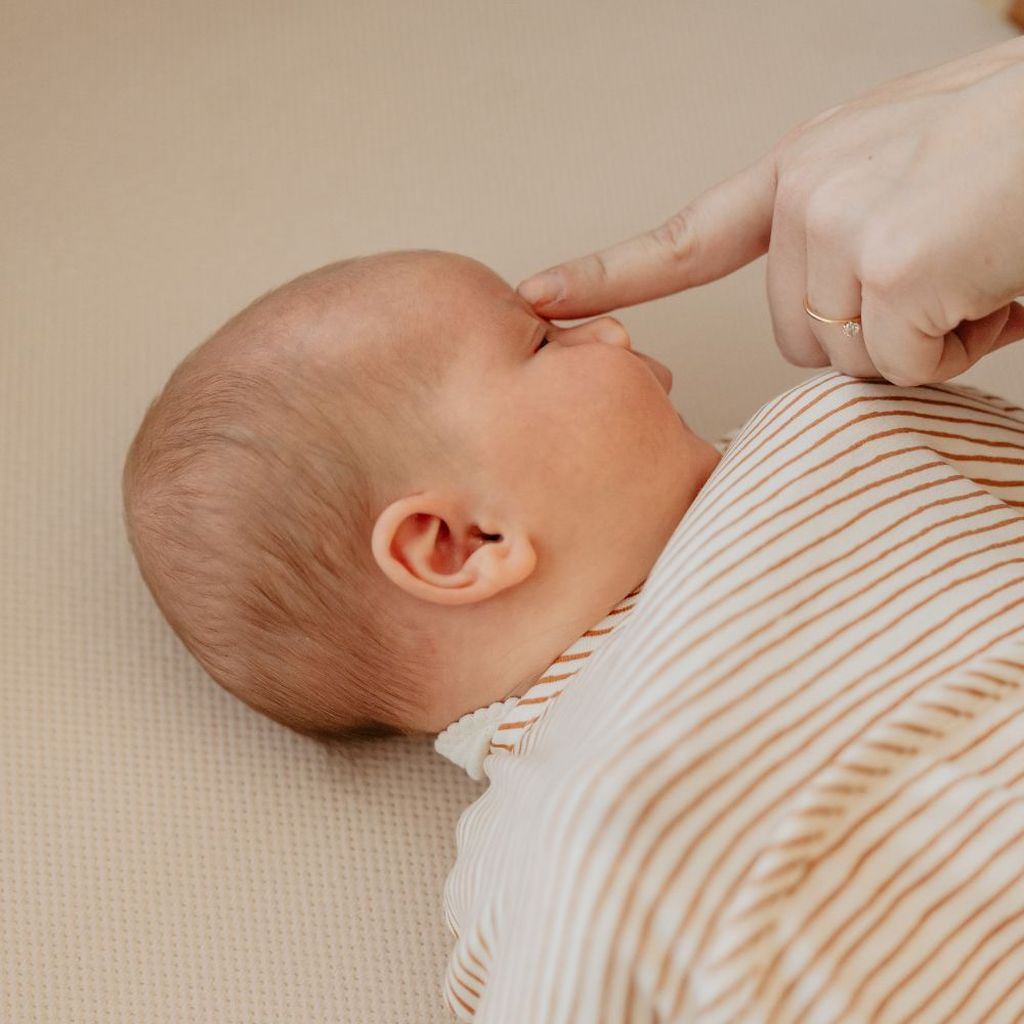
Keep contact a little longer after laying your baby down
When your baby is lying in bed, the transition from your arms to the mattress can feel big and unfamiliar.
Try leaving your hands resting gently on their tummy or chest for a few extra seconds. This allows your baby to keep feeling your warmth and closeness while slowly drifting deeper into sleep. This small moment of continued contact can often help prevent restlessness.

Move slowly and with intention
Babies are very sensitive to movement. Quick or sudden actions can wake them again, even when they seem to be deeply asleep.
Try to move calmly and with control, almost as if you are moving in slow motion. The same applies when you leave the room: do so quietly and without rushing. A peaceful environment helps support your baby as they continue to settle into sleep.

A familiar scent creates a sense of safety
Babies recognize their parents not only by voice and touch, but also by scent. Your smell has a calming effect and gives a strong sense of safety.
A small comfort cloth that has rested close to you for a while, or a sleep sack carrying your familiar scent, can help make the crib feel more reassuring. This can help your baby feel less alone when being laid down.

Practicing during the day makes evenings easier
Laying your baby down is a skill you develop together. Short practice moments in the crib or playpen during the day can help make the evening transition smoother.
Approach this without pressure or expectations. Sometimes it works, sometimes it does not, and that is completely okay. Every calm practice moment helps build trust and familiarity.
Every baby is unique
Not every baby can be laid down without protest, and that does not mean you are doing anything wrong. Each child has their own temperament and their own need for closeness.
For some babies, staying close is not a luxury but a genuine basic need. This is not about spoiling them. It is about supporting their sense of safety and secure attachment.
As midwives, we are happy to look at things together with you. Side by side, we explore what works best for your baby and for you as parents, with calm, trust and attention to what fits your family.
Ook interessant

Acid reflux, heartburn and indigestion in pregnancy
While it’s not harmful, it can feel horrible, but read on to find out how to make those gastric symptoms less ghastly.

Everything you need to know about baby sleep
Babies and sleep: sometimes it feels like magic, but with the right knowledge, it becomes simple logic. Whether your baby is just born or already a few months old, good sleep is crucial for growth, development, and rest. Sleep expert Nathalie Schittekatte shares her best tips for peaceful nights all the way to the first birthday.

Breastfeeding, bottle feeding and sleep: a rhythm of closeness and trust
Feeding your baby is so much more than simply satisfying hunger. It is a moment of pure intimacy, a small ritual filled with warmth, security, and reassurance. Whether you breastfeed or bottle-feed, every feeding moment is an opportunity to embrace your little one with attention, eye contact, and love. These small moments are what create a deep bond and help you discover a safe rhythm together.